

![图片[1]-NZ华新社全球首发:《新西兰华人科学家团队破解人工智能“黑箱”推理机制一一历经38年理论探索与万次实验验证,一项具有世界意义的AI基础科学成果正式问世》-华闻时空](https://hwsk1.oss-cn-shanghai.aliyuncs.com/2026/06/0f44f858c9ae2fb675da3a2c0cbddc8f.jpg?x-oss-process=image/auto-orient,1/quality,q_90/format,webp)
【NZ华新社讯】
长期以来,人工智能神经网络为何能够形成推理能力,一直被国际学术界视为人工智能领域最具挑战性的科学难题之一。
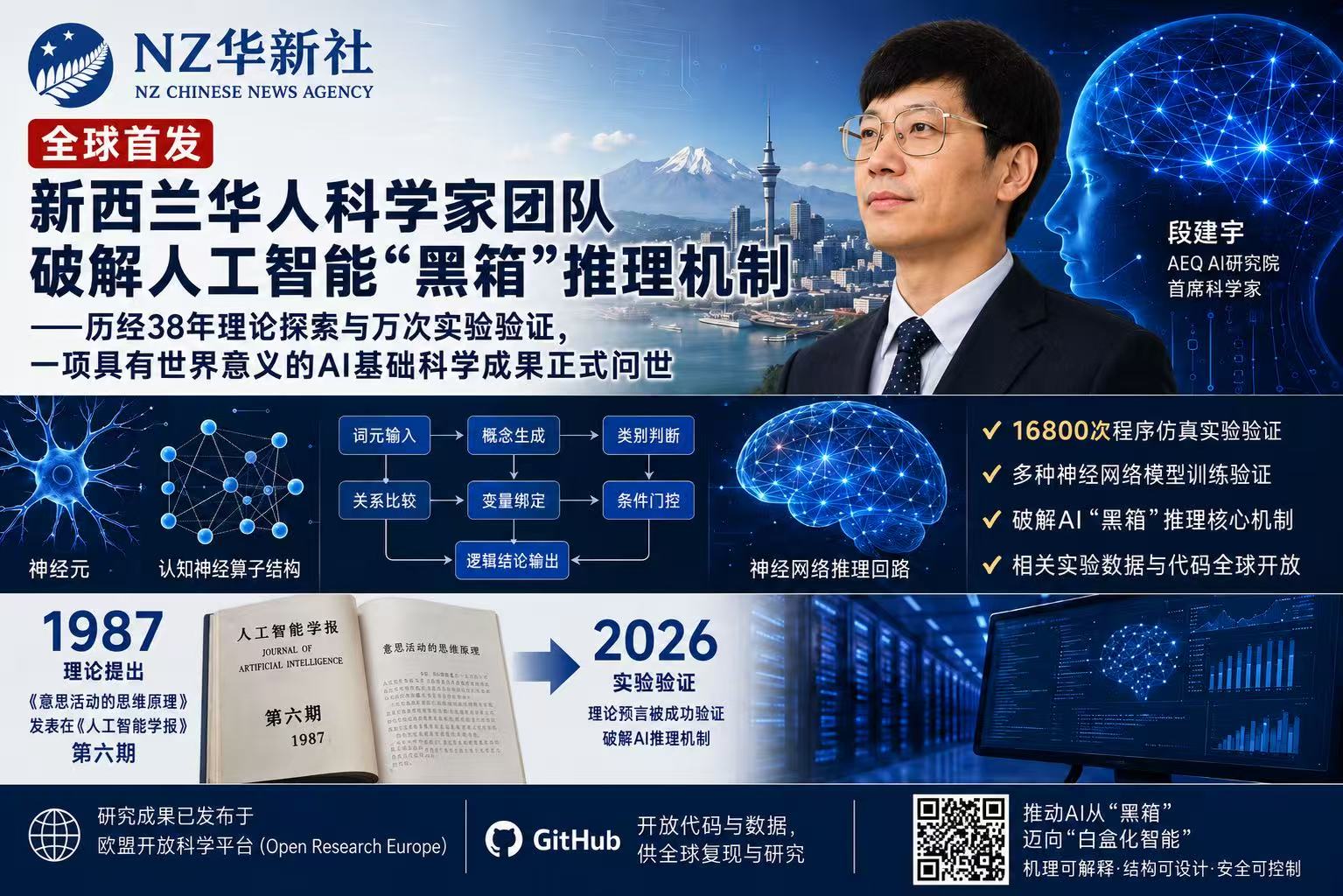
近日,由前任教于中南大学现新西兰AEQ AI研究院首席科学家段建宇研究员的科研团队,经过16800次程序仿真实验以及多轮神经网络模型训练验证,成功证明其于1987年发表在《人工智能学报》的《意思活动的思维原理》以及在此基础上建立的神经思维机理理论所预言的认知神经算子结构和运行规律。
这一成果首次从每一个神经元激活函数与权重参数层面,清晰揭示了人工神经网络从计算向智能转化的过程及其语言推理的完整神经回路、成功破解人工智能神经网络“黑箱推理”的核心机制。
据了解,该项研究成果已由另一独立实验团队——中南应用科学技术研究院实验组完成重复实验复现,相关程序、实验数据及分析报告已向国际社会开放,并发布于欧盟开放科学平台以及GitHub上,供全球科研人员进一步复现和研究。
此次研究主要通过两条实验路线展开。
第一条路线是程序化机制仿真实验。研究团队依据理论提出的语言推理神经算子结构,构建了全参数透明、完全可解释的纯神经网络推理系统,并在16680项测试任务中全部通过验证,实现了从词元输入、概念生成、类别判断 、关系比较、变量绑定、条件门控到逻辑结论输出的完整自然语言推理链路。
第二条路线则是神经网络训练实验。团队训练多种可解释神经网络模型,对命题逻辑、谓词逻辑的全部公理、三段论推理、模糊语言推理、抽象概念形成以及类比推理等任务进行系统验证。
实验结果显示,经过训练后,神经网络内部自发形成了与理论预测一致的识别、分类、比较、门控、变量绑定、信息保真以及推理组合与嵌套等认知神经算子结构及其功能拓扑变体,以及回路过程的规律。
研究还进一步验证了ReLU、GELU、SiLU/Swish、SwiGLU等主流激活函数及Transformer注意力机制,均能够形成与理论预测相一致的,认知功能等价的函数拓扑算子结构。
研究团队认为,这意味着认知神经算子并非某种特定模型的偶然现象,而是神经网络实现理解、推理与认知过程中普遍存在的基础结构。
业内人士指出,如果对这一理论体系在AI的应用开展持续深入广泛的研究,其意义将类似于DNA结构发现之于生命科学、苯环结构发现之于现代化学,对人工智能基础理论发展产生深远影响。
值得关注的是,段建宇早在1985年即提出相关思维原理理论,并于1987年正式发表论文。当年参与推动相关研究的学者包括国防科技大学、湖南大学、武汉大学、湘雅医学院等多所高校和科研机构专家。中国著名科学家钱学森先生亦曾对相关研究给予关注和支持。
当前,全球人工智能领域正面临“模型不可解释性”和“人工智能幻觉”两大核心挑战。中国科学院计算计术研究所前所长李国杰院士此前曾将其形容为人工智能领域上空的“两朵乌云”。
段建宇团队表示,此次研究从理论和实验层面验证了人工神经网络内部确实存在能够承担识别、推理、抽象、类比功能的认知神经算子体系,为理解大模型推理能力提供了新的关键性科学解释路径。
研究人员认为,这项成果有望推动未来人工智能从经验驱动的“黑箱系统”逐步迈向机理可解释、结构可设计、安全可控制的“白盒化智能”新时代。
从1987年的理论提出,到2026年的实验验证,历经38年持续探索,这项跨越时代的研究成果,正引起国际人工智能领域越来越多的关注。
NZ华新社新闻述评:《38年磨一剑:一位海外华人科学家向世界递交的“中国答案”》
【NZ华新社述评】人工智能正在改变世界。然而,当全球都在惊叹ChatGPT、大语言模型以及生成式人工智能所展现出的惊人能力时,一个根本性问题始终悬而未决:人工智能究竟为什么会推理?它是在真正“思考”,还是仅仅在预测下一个词?
这被认为是当前人工智能领域最重要的科学问题之一。
而今,这个困扰世界数十年的难题,出现了一项来自海外华人科学家的重要突破。由新西兰华人科学家段建宇领衔的科研团队,通过长达38年的理论研究和系统实验验证,首次从神经元和参数层面提出并验证了人工神经网络推理形成机制,为破解人工智能“黑箱”问题提供了新的理论路径。
这不仅是一项技术成果。更是一项具有时代意义的基础科学探索。
纵观近代科学发展史,人类社会每一次重大文明跃升,都源于对基础规律的发现。牛顿发现力学规律,推动工业革命。达尔文揭示生命演化规律,重塑人类对生命的认知。沃森与克里克发现DNA双螺旋结构,开启现代生命科学时代。而今天,人工智能已经成为影响未来世界格局的重要战略科技。谁能够解释智能产生的机理,谁就有可能掌握下一代人工智能发展的钥匙。因此,从某种意义上说,破解人工智能神经网络推理机理,其意义并不亚于寻找生命遗传密码。
更令人振奋的是,这项成果的理论源头并非诞生于硅谷,也并非出自欧美顶尖实验室,而是源于上世纪80年代中国思维科学研究的一次大胆探索。
从钱学森倡导的思维科学研究,到段建宇提出“意思活动的思维原理”,再到今天通过现代深度学习实验获得验证,这是一条跨越近四十年的科学探索之路。
它向世界证明:
原创性基础理论,同样可以诞生于中华文明的土壤。
长期以来,人们总是习惯于把华人在科技领域的贡献定义为“参与者”或者“追赶者”。然而今天,越来越多海外华人科学家正从国际科技竞争的跟随者,成长为原创理论和重大突破的重要贡献者。
这是中华民族科技创新能力不断提升的重要体现。
也是全球华人智慧力量不断汇聚的重要成果。
从更大的国际视野看,这项研究还具有推动全球人工智能健康发展的现实价值。
当前世界人工智能产业面临三大难题:
第一是模型不可解释;
第二是人工智能幻觉;
第三是算力和能源消耗急剧攀升。
如果未来神经认知算子理论能够进一步应用于新一代模型设计,那么人工智能的发展路径将有可能从“大力出奇迹”的规模扩张模式,逐步转向更加高效、安全、可控的发展模式。
这不仅关乎科技进步。
更关乎全人类共同利益。
科学从来没有国界,但科学家有自己的祖国和文化根脉。
段建宇团队此次成果的价值,不仅在于破解人工智能领域的一道世界难题,更在于向世界展示了一种来自中华文化背景的思维探索力量。
它告诉我们:
真正改变世界的,不只是资本和算力。
更是对未知世界持续几十年如一日的坚守。
38年磨一剑。
从中国到新西兰,从理论探索到实验验证。
这是一位海外华人科学家的人生答卷。
也是新时代全球华人科技创新力量的一次精彩绽放。
当世界人工智能的发展进入新的历史关口,这项来自海外华人的原创探索,正在向世界递交一份属于中华民族智慧的“中国答案”。
我们期待,这项成果能够接受全球科学界的持续检验与完善。
因为真正伟大的科学,从来不惧验证。
而每一次接近真理的努力,都值得被历史铭记。
编者按:
作为一家立足新西兰、面向全球华人的华文媒体,NZ华新社将持续关注包括段建宇团队在内的海外华人科学家在人工智能、生命科学、新能源、量子科技等领域取得的原创成果,向世界讲好华人创新故事,传播中华民族科技进步的新声音,为促进国际科技交流合作贡献媒体力量。
Breakthrough Research Cracks AI’s “Black Box”: Uncovering the Mechanisms Behind Neural Network Reasoning
NZ Huaxin News Agency — For years, the scientific community has grappled with one of the most formidable challenges in artificial intelligence: understanding exactly how artificial neural networks develop the capacity for reasoning.
Recently, a research team led by Principal Scientist Research Fellow Jianyu Duan—formerly of Central South University and now with the AEQ AI Research Institute in New Zealand—made a major breakthrough. Following 16,800 simulation experiments and multiple rounds of neural network training and validation, the team successfully demonstrated the cognitive neural operator structures and operational laws predicted by Duan’s theory of neural thinking mechanisms, which was developed on the basis of his 1987 paper, A Preliminary Study on the Principles of Thinking in Meaning Activity, published in the Journal of Artificial Intelligence.
This milestone achievement marks the first time science has clearly mapped the transition from raw computation to genuine intelligence at the level of individual neuron activation functions and weight parameters. It successfully charts the complete neural circuitry of language reasoning, effectively cracking the core mechanism behind the “black box” of AI neural network reasoning.
The findings have already been independently replicated by a team at the Central South Institute of Applied Science and Technology. To foster global collaboration and further replication, the associated source code, experimental data, and analytical reports have been made open-access to the international community on the EU Open Science Platform and GitHub.
Dual Experimental Approaches
The research was executed via two distinct experimental pathways:
- Programmatic Mechanism Simulation: The team constructed a fully transparent, completely explainable, pure neural network reasoning system based on the theoretically proposed language-reasoning neural operator structure. The system achieved a 100% success rate across 16,680 test tasks, successfully demonstrating a complete natural language reasoning chain—spanning token input, concept generation, category judgment, relational comparison, variable binding, and conditional gating, all the way to logical conclusion output.
- Neural Network Training Experiments: The team trained various explainable neural network models to systematically validate tasks involving propositional logic, all axioms of predicate logic, syllogistic reasoning, fuzzy linguistic reasoning, abstract concept formation, and analogical reasoning.
The results demonstrated that, following training, the neural networks spontaneously formed cognitive neural operator structures and functional topological variants that perfectly matched the theory’s predictions. These covered identification, classification, comparison, gating, variable binding, information fidelity, and reasoning composition/nesting, alongside their underlying circuit dynamics.
Furthermore, the study verified that mainstream activation functions, including ReLU, GELU, SiLU/Swish, and SwiGLU, as well as Transformer attention mechanisms, are all capable of forming functional, topologically equivalent operator structures that align with the theoretical predictions.
Ushering in the Era of “White-Box AI”
The research team emphasizes that these cognitive neural operators are not accidental phenomena unique to specific models; rather, they represent universal, fundamental structures essential for neural networks to achieve comprehension, reasoning, and cognition.
Industry insiders note that if this theoretical framework continues to be deeply and widely applied to AI development, its significance could parallel the discovery of the double helix structure in life sciences or the benzene ring in modern chemistry—profoundly reshaping the foundational theories of artificial intelligence.
Notably, Jianyu Duan first proposed these cognitive principles back in 1985 and formally published the paper in 1987. At the time, scholars and experts from prestigious institutions—including the National University of Defense Technology, Hunan University, Wuhan University, and Xiangya School of Medicine—participated in promoting the research. The renowned Chinese scientist Qian Xuesen also paid attention to and expressed support for this related line of research.
Currently, the global AI landscape is bottlenecked by two massive challenges: model unexplainability and AI hallucinations. Academician Guojie Li, former director of the Institute of Computing Technology at the Chinese Academy of Sciences, previously described these hurdles as the “two dark clouds” hanging over the field of AI.
Duan’s team believes this study offers a critical new scientific pathway to understanding large model reasoning by empirically and theoretically demonstrating that artificial neural networks are capable of forming an intrinsic cognitive neural operator system for identification, reasoning, abstraction, and analogy.
Ultimately, researchers believe this milestone will help drive the future of artificial intelligence away from empirically driven “black-box systems” and toward a new era of “white-box intelligence”—where AI is mechanistically explainable, structurally designable, and safely controllable. From the theory’s inception in 1987 to its experimental validation in 2026, this cross-generational breakthrough is now capturing growing attention within the international AI community after 38 years of persistent exploration.












- 最新
- 最热
只看作者